Someone recently asked me what I thought it meant to be professional. The question wasn’t posed directly. It came wrapped in commentary, in the familiar folds of appearance and assumption. It was about how one shows up, how one dresses, what one reveals or conceals.
I’ve been turning it over ever since. Not just the question itself, but the weight of it. The way professionalism so often becomes less about how we work and more about how we appear while doing it.
Professionalism, I’m learning, is often code. A set of quiet agreements about what’s acceptable, respectable, palatable. It asks us to tone ourselves down, to be less loud, less tender, less queer, less angry, less visible. To tuck parts of ourselves away.
It’s code for whiteness. For cisnormativity. For masculinity dressed in neutrality and passed off as “objective.” It’s code for uninked skin and hairstyles that don’t “distract.” For voices that don’t rise and bodies that don’t insist. There is a quiet surveillance embedded in these expectations, one that measures our worth by how little of our difference we dare to show.
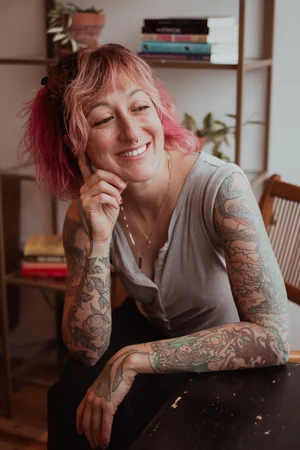
As someone who walks into a room with stories already written on my skin, inked across my body, I know this code well. I’ve felt the moment eyes scan and pause, the quick mental calculation: Is she safe? Is she serious? Is she professional?
There’s a lyric by Nirvana that comes to mind: “I’m not like them, but I can pretend”
Some of us have built entire careers pretending, shaping ourselves into what’s acceptable, promotable, survivable. And there are reasons for that. Material reasons. Sometimes the ability to make a living, to remain safe, to access opportunities, depends on how convincingly we can perform what is expected of us. But the pretending hollows. For many of us, it was never particularly convincing anyway.
I've been thinking about what professionalism might mean if we understood it through the quality of our presence rather than the performance of a particular image. If we took seriously the ways care, clarity, listening, and witnessing are expressions of competence. Not simply pleasant additions to the work, but central to how we do it.
I think of how bell hooks wrote about love as an ethic, how justice lives not just in our ideas, but in our gestures, our rhythms, our boundaries. And I think about how little room our conventional ideas of professionalism leave for contradiction, softness, or rest. So many of us carry our labor in bodies that cannot and will not be streamlined.
For queer folks, for trans and gender-nonconforming folks, for Black and brown people, for disabled people, for anyone who doesn’t fit neatly into the box labeled appropriate, this code does more than restrict expression. It can demand erasure.
Sometimes surviving that demand means folding parts of ourselves away to stay safe. It means passing, withholding, shrinking. I don't want to dismiss those decisions or romanticize visibility as though everyone has equal freedom to choose it. There are consequences to being seen, and those consequences are not distributed equally.
Still, I want to name what it costs us. What it takes to become legible to a system that was never built to hold us with care. What it means to silence the sacred ways we signal one another through dress, gesture, tattoo, language, and flair.
Because many of us are professionals not in spite of our differences, our expressiveness, our identities, but in ways deeply informed by them. We’ve learned to read rooms with our whole bodies. We've cultivated forms of attention, resilience, and care that emerge from having to navigate spaces where our belonging is never entirely assumed. These experiences shape what we notice, how we relate, and what we understand about the people who come into our care.
I’ve started reclaiming professionalism, not by rejecting it altogether, but by reconsidering what I actually want it to mean in my life and work.
I want to be anchored in my practice without needing to be buttoned-up. I want to make room for the tattooed body and the soft voice, the sharp analysis and the tender pause. I want to know when to speak with fire and when to sit in silence, and to trust that both can come from a place of integrity.
I no longer want to contort myself to appear “neutral.” My humanity is present in my cadence, my clothes, the way I decorate my skin and my space. These things don't undermine my capacity to do meaningful, ethical work. They are part of how I inhabit the world, and I am tired of the assumption that professionalism requires me to pretend otherwise.
I’m reminded of something Jenny Odell wrote: “The point of doing nothing... isn’t to return to work refreshed and ready to be more productive, but rather to question what we currently perceive as productive at all.”
I think there's something similar worth considering here. Reclaiming professionalism cannot simply mean finding better ways to participate in the same old expectations. At some point, we have to question the expectations themselves. Who established them? Whose comfort do they protect? Who is permitted to be seen as competent without first having to prove that their body, their expression, or their way of being belongs in the room?
The more I consider these questions, the more I notice how they show up in my work, my relationships, and the communities I serve. There is something that happens when people encounter someone who is comfortable enough in their own humanity to make room for theirs. I've witnessed people soften, open, and begin to trust. Not because I've abandoned my professional responsibilities, but because I can inhabit those responsibilities without disappearing behind them.
Of course, this isn't always easy. There are still rooms that ask me to shrink, and moments when compromise feels necessary. I imagine there always will be. I don't think reclaiming professionalism means arriving at some place where I am entirely unaffected by other people's expectations. But I am becoming clearer about who I am, what matters to me, and what I am willing to negotiate.
I believe we're allowed to be whole, even in our workplaces. Especially there, perhaps, given how much of our lives we spend working.
And I keep returning to care. What might it mean to understand professionalism as an ethical relationship to the people we work with, rather than a collection of aesthetic and behavioral expectations? What would change if honesty, accountability, curiosity, and care were given more weight than our ability to look the part?
I wonder about those of us who have been told we're too much. Too loud, too visible, too expressive. Those who have been asked, directly or indirectly, to cover something up, tone something down, or make ourselves easier to digest.
What might professionalism look like if it were shaped by our actual values and experiences, rather than inherited scripts about how a professional person should appear?
I don't imagine there is one answer. Nor do I think authenticity alone makes someone ethical or competent. We still have obligations to the people we serve, to our colleagues, and to the communities in which we work. We still need boundaries, accountability, skill, and a willingness to recognize the limits of what we know. But none of those things require the erasure of our humanity.
Perhaps that's where I find myself now, trying to understand how my body, my expression, and my values can belong to the work without having to justify their presence.
I keep asking myself what kind of professional I want to be. Who does my professionalism serve, and who does it silence? What do I lose when I dress the part but abandon the pulse of what I know to be true?
I don't have a clean conclusion. I still feel the discomfort of being read before I've spoken. I still recognize the temptation to make myself more palatable in certain rooms. And I know there will be times when I make that choice.
But I am less interested in being perceived as professional than I am in practicing with integrity. I want to honor my becoming more than any role I've been assigned, and to keep showing up as myself, even when that self is a little unruly.
I'm curious what becomes possible when we stop treating our humanity as something we must overcome in order to be taken seriously.
Yours in devotion to the mess and the making,